
The workforce of tomorrow depends on the students of today and their opportunities to hone in-demand and relevant digital skills. At present, however, there is a stark misalignment between student skill sets and the workforce demands of local economies.
In a recent crosswalk analysis of data from the US Census; the US Department of Education; the Integrated Education Data System; the Georgetown University Center on Education and the Workforce; and the Department of Agriculture, Commuting Zones and Labor Market Areas, Georgetown researchers identified hundreds of labor markets across the country where local economies are struggling to achieve strong alignment between the demand for middle-skills credentials (i.e., certificates and associate’s degrees) and the supply of these credentials available and produced by local education institutions. Researchers have aptly dubbed this phenomenon “The Great Misalignment.”
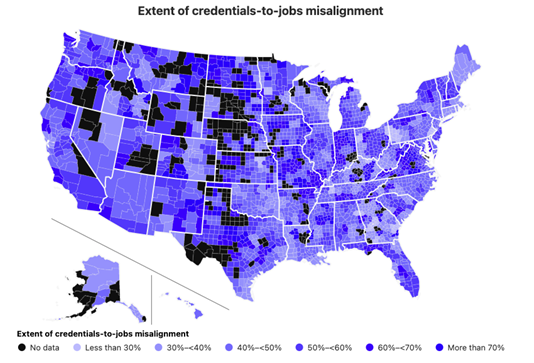 In today’s workforce, digital skills are no longer optional. They are essential, with some venturing as far as to call these skills a workplace non-negotiable. Employers across industries increasingly require proficiency in tools like Microsoft Excel, Google Sheets, and Adobe Photoshop, to name a few, yet a significant skills gap persists. To bridge this gap, we must start preparing students earlier, ensuring they gain both foundational knowledge and industry-recognized validation of digital skills.
Current and Growing Demand for Digital Skills
Industry demand for digital literacy has skyrocketed, with middle- to high-wage jobs requiring a baseline proficiency in workplace technologies. In fact, according to the National Skills Coalition (NSC), 92% of 2021 job postings required digital literacy. Based on over 43 million postings across a wide variety of sectors and industries, this data point clearly demonstrates the importance of some level of digital skills competence regardless of career path. However, previous NSC research found that one-third of workers fail to have the foundational digital skills needed to enter and thrive in today’s workforce.
While persisting gaps are certainly perpetuated by disconnects between post-secondary coursework and the real demands of the workforce, there is immense opportunity for K-12 districts and partner organizations to close this gap earlier. The misalignment between K-12 education and employment opportunities means many of today’s students are graduating without the practical skills needed for career success.
By integrating certifications that verify students’ digital competencies within K-12 education, schools and districts ensure their graduates are more competitive in both college admissions and the job market. However, with numerous systemic challenges—teacher shortages, teachers’ confidence in digital skills education, funding barriers, and more—there are real hurdles that K-12 institutions face, making it difficult to address this critical gap. Schools and districts need proven, sustainable solutions.
Power of Industry-Recognized Credentials in K-12 Education
In a recent edWeb webinar, the majority of the K-12 educators in attendance cited the inability to validate students’ skill mastery as a major challenge in college and career readiness efforts. Digital certification programs, such as those offered by Tosa, provide a viable and sustainable solution. These credentials confirm students’ proficiency in real-world applications, giving them tangible proof of their abilities. Further, stackable certifications allow students to advance from beginner to expert levels in programs like Microsoft Excel and Google Docs, offering continued skill development throughout their education.
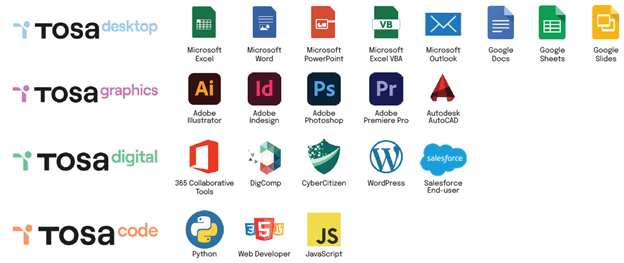
A well-rounded K-12 digital skills certification program will ensure students are future-ready by offering certifications in essential, in-demand areas such as:
- Microsoft Suite and Google Suite
- Graphic design applications
- Cybersecurity and digital literacy
- Web design tools
- Coding and web development
To align education with workforce needs, schools and districts must embed industry-recognized credentialing within K-12 coursework. This approach benefits students in several key ways:
- Increased Employability: Digital certifications enhance students’ job prospects by proving their skills to employers. According to a recent Society for Human Resource Management (SHRM) report, a majority of all employer groups—88% of executives, 76% of supervisors, and 78% of HR—view employees with alternative credentials more favorably when considering promotions or completing succession planning activities.
- Higher Earning Potential: Research consistently shows that workers with verified digital skills earn higher wages than their non-certified peers. A 2022 study conducted by Amazon Web Services and Gallup found that workers who regularly use intermediate or advanced digital skills in their work earn 40-65% higher salaries than those who do not use digital skills in the workplace.
- College Readiness: Certifications provide an edge in college applications, demonstrating a commitment to technical proficiency and lifelong learning.
- Confidence and Competence: Mastery of digital tools is proven to boost student confidence, leading to greater academic and professional success.
Choosing the Right Digital Certification Platform for K-12
To effectively bridge the digital skills gap, K-12 schools must integrate certification programs that equip students with practical, industry-aligned competencies. Starting digital certification in middle school, or earlier, ensures students build essential skills over time and have the exposure needed to make informed decisions about their future career pursuits. However, implementing these programs at scale comes with challenges, including resource constraints, teacher confidence in digital instruction, and the need for flexible, accessible solutions.
An effective digital certification solution should address these challenges through:
- Seamless Curricular Integration: Certification programs should align with existing coursework and state or national standards to complement, rather than add to, educators’ workload.
- Adaptive Assessments: Proficiency-based testing ensures students are evaluated on their actual skills, allowing them to progress at their own pace and clearly identify individual strengths and areas for growth.
- Comprehensive Reporting: Schools and educators need detailed progress tracking to measure student growth and strategically inform instruction.
- Flexible, Stackable Credentials: Students should have opportunities to develop skills at multiple levels, from beginner to advanced, across a variety of essential tools and technologies.
Tosa: The Future of K-12 Digital Skills Education
In addition to the above characteristics, Tosa by Isograd offers a sustainable approach to digital certification that takes into account the unique realities of K-12 education in the United States today. Tosa digital certifications are:
- Accessible and Inclusive: With multilingual assessments and built-in accessibility features, Tosa ensures all students can engage with digital skills learning.
- Efficient and Scalable: A 100% browser-based platform means no software installations or IT maintenance, making it easy to implement across classrooms and districts.
- Data-Driven and Measurable: Adaptive testing and pre- and post-assessment reports give educators clear insights into student progress, helping them tailor instruction to individual needs.
By embedding industry-recognized digital certifications into K-12 education, schools better prepare students for both college and the workforce—empowering them with validated skills that open doors to future opportunities.
Tosa provides an industry-leading certification model that ensures students gain validated, real-world digital competencies. As we continue to focus on workforce readiness, it’s clear that digital skill certification must start early—empowering students to take control of their futures with the skills employers demand.
To learn more, explore the integration of digital skills certification in K-12 in this edWeb webinar.